A friend of mine was working with a realtor, to purchase his first home, and I told him to call me with any questions. Well he did the very next day. He found this older home he liked, but he had some concerns about the attic. The attic had about a foot of wood shavings between the ceiling joists, and he did not know why it was there. His agent said, she had never heard of wood for insulation, but that is what it looked like to her, but she did not know if wood had any insulation value. Well she was right; it was a practice in older houses to use wood shavings for insulation, along with other strange things like horsehair, ground paper, and rock wool. As a home inspector, I have seen a lot of different products for insulation.
Actually, wood shavings do have some insulation value. Common cellulose loose fill insulation is about 3.5 “R” value per inch, wood shavings is about 2.5 “R” value per inch. Cellulose is the most common loose fill insulation used today. This insulation is a paper product with additives to provide resistance to fire and mold/fungus growth.
The problems with wood shavings are it is hard to treat against fire, vermin, and fungal growth. Also wood shavings are heavy and may be too heavy for some attics.
Steve did by the house and I told him I would help him change the insulation when he was ready. That was in the summer of 1989, and he has not been ready yet.
Thursday, July 10, 2008


Wednesday, July 9, 2008
We need Shock Collars


I won’t start out with cheesy phrases like; “Don’t be shocked what you find on a home inspection”, or “That inspection got me wired”. Okay, I guess, I can’t help myself.
But the fact of the mater is you never know what condition you may find the electric wiring in on a home inspection. Besides the outdated equipment, faulty equipment, recalled equipment, we most often find amateur wiring. Amateur wiring is just a nice way of saying poorly done and unsafe wiring. Over the years I have seen some very clever ways to wire things the wrong way.
Somebody stop these people!
The only way I know to keep this kind of stuff from happening is to make anyone working on the house wear a shock collar, and receive a good jolt any time they start to do something stupid. But until then we will keep seeing unsafe amateur wiring.
I thought I would share these pictures from a friend and a fellow home inspector in Tennessee. By the way they did not remove the main panel cover, every thing is just like they found it.

If you like pictures of unsafe wiring, let me know and I will post more.
But the fact of the mater is you never know what condition you may find the electric wiring in on a home inspection. Besides the outdated equipment, faulty equipment, recalled equipment, we most often find amateur wiring. Amateur wiring is just a nice way of saying poorly done and unsafe wiring. Over the years I have seen some very clever ways to wire things the wrong way.
Somebody stop these people!
The only way I know to keep this kind of stuff from happening is to make anyone working on the house wear a shock collar, and receive a good jolt any time they start to do something stupid. But until then we will keep seeing unsafe amateur wiring.
I thought I would share these pictures from a friend and a fellow home inspector in Tennessee. By the way they did not remove the main panel cover, every thing is just like they found it.


If you like pictures of unsafe wiring, let me know and I will post more.
Tuesday, July 8, 2008
Money Pit
Several years ago I ran an article in the HomeTeam News about the problems with FP panels. Since then I have had a first hand experience with a main panel failing in my own house. I purchased a house that needed a complete up-date. I decided to live in the house, wile I did the much-needed repairs. The house came with a thirty-year-old Federal Pacific panel as the main, and the plan was to replace it after I had finished all of the other electrical work. That did not happen! What did happen was I received a call at work from my wife telling me this; “We have a problem”. “Do you remember the movie Money Pit”? “Do you remember the scene in the kitchen where the electrical wires were burning through the walls”? “Well that is the same problem we have”. What had happened is an old wall plug had failed under use and created a direct short. This is when a circuit breaker should do its job, and shut off the electricity to that circuit, it did not. Fortunately it happened during the day when my wife was home to shut off the main breaker. In a short period of time the electrical-short had caused the wires in the wall to burn, and the breaker that was supposed to shut off the current in the case of an emergence had melted it self in the panel, and it was still on! I never spent another night in that house with the FP panel.
Monday, July 7, 2008
Federal Pacific Problems
The most common problematic panel is the “Federal Pacific” stab lock panel. Federal Pacific Stab-Lock panels and their breakers are trouble prone and unreliable. Problems not only include breakers that fail to trip, but also arcing at the bus bars. The connections between the bus  bars and the breakers sometimes loosen with age, and use, this can cause arcing. This arcing is on the back of the breakers and can’t be seen without removing the breakers. The parts for these panels are expensive and hard to find.
I have had FP Breakers pop out of the panel when I removed the dead face, to inspect the panel. This will take you by surprise, but when the breaker leaves the buss bar, it is no longer energized and can not shock you.
These panels are unreliable and should be replaced with modern, reliable equipment. In the 1980’s, from 1983 to 1987, the Consumer Product Safety Commission conducted extensive testing of these breakers with an aim to determining whether they represented a significant threat to homeowner safety. CPSC never issued an official ‘finding’ that the panels constituted a hazard, because their investigation was suspended due to lack of funding. However, the testing completed did find that a high percentage of these breakers failed during testing.

As home inspectors we will all see some of theses panels and when we do, at the very least, they should be reported as having a history of failure to trip when needed and be evaluated by a licenced electrician.
I found Daniel Friedman's site to be the very best source of information on Federal Pacific panels, and I highly recommend reading it if you are in the business of home inspecting, or if you have a FP panel in your house.
More on FP Panels tomorrow.
 bars and the breakers sometimes loosen with age, and use, this can cause arcing. This arcing is on the back of the breakers and can’t be seen without removing the breakers. The parts for these panels are expensive and hard to find.
I have had FP Breakers pop out of the panel when I removed the dead face, to inspect the panel. This will take you by surprise, but when the breaker leaves the buss bar, it is no longer energized and can not shock you.
These panels are unreliable and should be replaced with modern, reliable equipment. In the 1980’s, from 1983 to 1987, the Consumer Product Safety Commission conducted extensive testing of these breakers with an aim to determining whether they represented a significant threat to homeowner safety. CPSC never issued an official ‘finding’ that the panels constituted a hazard, because their investigation was suspended due to lack of funding. However, the testing completed did find that a high percentage of these breakers failed during testing.

As home inspectors we will all see some of theses panels and when we do, at the very least, they should be reported as having a history of failure to trip when needed and be evaluated by a licenced electrician.
I found Daniel Friedman's site to be the very best source of information on Federal Pacific panels, and I highly recommend reading it if you are in the business of home inspecting, or if you have a FP panel in your house.
More on FP Panels tomorrow.
P.S. The pictures were sent from "Scully and Mulder".
Thursday, July 3, 2008
Can You Say "Zinsco"


As a home inspector we find problematic panels, these panels with a history of problems that can led to safety concerns.One of these panels that we see is the “Zinsco”. Many of these panels were installed in single-family homes, multi family apartments, and condos in the 1960's and 1970's. They are easily identified because of the bright colored breakers.
Originally the Zinsco panels were made in Puerto Rico. Zinsco later sold their manufacturing plants to Sylvania, who then marketed them under the Sylvania brand until finally closing down.
Some of the ones that I have seen have buss bars made of aluminum. This material will corrode quite easily. A corroded buss bar can present a real hazard. I have seen pictures of these panels that have gone into meltdown. The breakers will arc on the buss bar and cause a bad connection, and this can cause a panel meltdown. These breakers also have a history of failing to trip in a current overload situation. This condition includes the Zinsco and the Sylvania panels. The only way to check the condition of the buss bar is to have an electrician remove all of the breakers. But if it was my panel, I would replace it. Truly, replacing these panels is the best way to assure safety.
Yes I know FP panels, I will discuss those tomorrow.
Wednesday, July 2, 2008
The Schocking Truth
I have received a lot of questions on the safety concerns of certain brands of electrical panels after a home inspector calls them out as a potential safety hazard. Here are two of the questions I hear the most; "If there is a problem with the panel, then why is it not recalled?","This panel has been in the house for thirty years, and it has never given me any problems, so why did the home inspector say it is a problem?" Stick with me and I will try to answer these questions.
The problems with most of the brands in question is internal arcing or a history of failing to trip their breakers when there is a problem. A breaker that fails to trip when there is a problem is the most serious. There appears to be no official recall on these panels, mainly because the companies that made these panels are out of business. But their history of having these problems is still a concern, because there are a lot on these panels still in use. •
A main breaker panel is basically a safety device that is designed to discontinue power to a circuit in the event of an overload. If an overload occurs in a circuit, and the breaker fails to trip, this can cause major problems, such as fire.
Knowing these problems exist with some of these panels, home inspectors will call out these panels as a potential danger. Some home inspectors recommend theses panels be evaluated by a licensed electrician, while others just recommend the panels be replaced. The point that gets raised is this panel has been in operation for thirty years with no apparent problems, now some body says it is a potential danger.
Unfortunately, in the case of electrical equipment, the “test of time” argument does not work. Under normal conditions, a circuit breaker does nothing but pass current --that is until an unsafe overload occurs. When such an overload happens, then it should trip to disconnect the circuit before any serious damage occurs. The problem is you do not know whether or not the breaker is defective. Even if an overload had occurred, it’s possible that no one noticed that wiring had begun to overheat or breakers had begun arcing. The only sure way to tell if the breakers will work when needed is to overload them, and observe their response. Unfortunately, such testing itself could affect their future performance.
In conclusion, the best way to assure the safety of your home is to have an inspection done by a qualified home inspector. He or she will advise you if any of this equipment exists in your house. Home inspectors should identify these panels as potential problems, but a lot of them may only recommend evaluation by a licensed electrician. But the safest thing to do is replace these panels with updated reliable panels. Because, not even the very best electrician can look at one of these panels and honestly tell if it will disconnect the circuit under an overload.
Tomorrow I will talk about panels by name, and fill you in on their history.
Tuesday, July 1, 2008
You have to Crawl before you Walk in the Basement

As a home inspector you know after many years to expect the unexpected, and even though you may have seen the same odd problem before, you just did not think you would see it a gain. But my good friends in Georgia, Bill And Janet, AKA Scully and Mulder have sent me pictures of a home they inspected that proves you can see this stuff over and over.
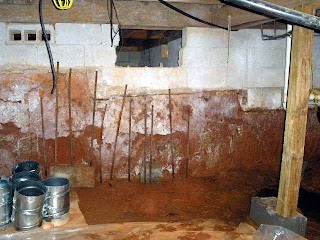

This house started out as a house with a crawl space, that’s right someone thought a basement would be a better idea. Don’t get me wrong, this conversion can be done correctly. But undermining the foundation of a house is never a good idea, even if you do add some non-standard support post.

Subscribe to:
Posts (Atom)
