Saturday, July 26, 2008

Fall Prep


TIPS FOR FALL HOME PREPARATION

As the hazy days of summer slowly become a distant memory, it is now time to focus on preparing your home for the fall. Advance preparations can save energy, increase safety and allow for an easy transition into the autumn months. Here are some tips to help you prepare for the winter to come:


Weatherize to Keep Your Home Energy-Tight


Use caulk on your home's exterior to seal out moisture and outside air; at the same time, it helps keep heat indoors. Caulk creates a tight moisture barrier which prevents rain and snow from seeping into gaps and joints, causing wood to rot and paint to blister.


Place a dollar bill between the door and the jamb or the window sash and sill. With the door or window closed, attempt to remove the bill. If it slides out easily, you're losing energy.

Clear Downspouts and Gutters

Avoid basement flooding and deterioration of the foundation by cleaning the gutter channels and clearing downspouts of debris. Replace deteriorating or broken gutters and downspouts.

Crank the Heat!
Turn on your furnace and give it a test-run.
Change the air filter. This will enable your heating system to run at maximum efficiency which can even help save money on heating costs.
If your home has gas heat, check the pilot light, burner and chimney flue. If not vented properly, you could have carbon monoxide building up in the house.

Prevent Trouble Down Below
There may also be things that need attending to beneath your property. For example, flush underground sprinkler systems before the cold sets in by blowing air into pipes to displace leftover water. This is important because water lines are typically only 6 to 8 inches below ground -- and prone to freezing. If they freeze and then burst, you could have a costly repair situation on your hands.

Check the Septic
Homeowners with septic tanks should also think about pumping them now -- before the ground freezes and snow buries your yard. Septic tanks should be checked once every year and cleaned no less than every three years.

Protect Your Pipes
Frozen or burst pipes are among a homeowner's worst nightmares. For a preventative measure, add insulation to pipes in unheated areas, which reduces heat loss from hot-water pipes and condensation on cold water pipes.
Install a freeze-proof outdoor faucet which will eliminate the problem of a frozen or broken spigot. These faucets employ a long stem that shuts the water off about a foot back in the house preventing the pipe from freezing.

· Conduct a Water Heater Check-Up
Just because your water heater seems to work fine now doesn't mean you should put off an annual inspection. Fall is a perfect time to have your tank's pressure and temperature relief valve inspected.

Friday, July 25, 2008

Wood to Soil Contact


One thing home inspectors look for is wood to soil contact. Wood to soil contact is when unprotected wood comes in contact with the ground. This is a problem because of moisture, and moisture will cause rot. Not only will moisture cause rot on the wood that comes in contact with the ground, but moisture can wick in to anything that the wood is attached to, even the house framing. Rot can be accelerated by increasing moisture; such as bad drainage or downspouts that drain close to the house.


Thanks to Sully and Mulder here are some pictures of wood to soil contact:

Thursday, July 24, 2008

Slow Drains

As a home inspector slow drains are something we all look for. The problem is that slow drains can be a simple fix, or can be an indication of a serious and expensive problem.

Here is an example of plumbing questions I receive;

“We live in a slab home that was built in the early sixties. We are on a public sewer system. We have lived here for ten years and up to this point we have never had a problem with slow drains. The weird thing is that the drains work fine, until we wash a lot of clothes, or take several baths in a row, and then every thing backs up”.


Judging from the age of your house and the symptoms you described, you have a clogged or collapsed yard drain. The drain line for the sewer runs from your house to the street, where it connects to the public sewer system. These lines can be crushed from tree roots or maybe just clogged. The reason that the drains only clog when you use a lot of water is because the lines are not completely clogged, but partially blocked. So after the lines drain, under light use, you have all of the lines to fill before it starts to back up. With heavy use, the lines fill faster then the partially clogged drain can drain.
For a temporary fix you can buy some drain line cleaning crystals, that you can flush down the toilet. But the best way to fix this is to have a plumber clean and scope the drain. If they tell you that you have “Orangeburg” pipe, you will need it replaced.

In this case it was Orangeburg pipe and it was crushed in the middle of the yard.

Tuesday, July 22, 2008

More from Scully and Mulder

If you are new to my blog, then I must explain that I make referance to my friends and fellow home inspectors in Georgia, as Scully and Mulder from the series X Files. Bill and Janet, AKA Scully and Mulder are always discovering strange things on their inspections. Somethings are just funny, but sometimes the odd things they find can be dangerous. Gas water heaters can be dangerous if the gas vent is not properly installed. Carbon monoxide from a non-standard venting system can cause health problems and in some cases even death.
Gas water heaters that are designed to vent naturally with out the aide of a mechanical venting system vent from the top. The vent pipe should not be reduced, it should always run uphill from the top of the water heater, and the pipe should be free from extensive rust and holes. Flat runs of pipe will collect condensation and cause serious rust problems.
As you can see from the picture at the top, the vent has been modified with sheet metal to vent from the side and not the top. It appears this was done because of limited overhead clearance. As you can see the vent pipe runs down and then flat. It that is not bad enough, it has an elbow turned down to make the final connection. The last picture shows what happens when condensation sits in a flat spot of a vent pipe.


I hope you enjoyed this and I am sure we will be hearing for Scully and Mulder soon.

Wednesday, July 16, 2008

Who's On Your Team?

Typically, buying a new home is the biggest investment of a person’s life. Many professional people play an important part in these transactions. Getting a professional to help find the house of your dreams and guide you through the entire process is an important step, but it does not stop there. Included are banks, title companies, surveyors, insurance companies and other risk management partners. Having the help of these professionals is important. It is also important to include a qualified/professional home inspector to this team.

Just twenty years ago, having a home inspection before closing was rare, but now over 80% of homebuyers are having a home inspection prior to closing. While this is an important step, it is equally important to choose the right home inspector.
Over the past twenty years the professionalism of inspectors and inspections has been on the rise. Although professionals in the business have been pushing for stricter regulations and state licensing requirements, it is still important to look for critical qualifications when choosing a home inspector.
To ensure a quality home inspection, a professional inspector should:
Be a member of a national organization that has established “Standards or Practice” and “Code of Ethics” for visual home inspections
Have attended an accredited Home Inspection Training Program
Receive Continuing Education Training annually
Have a resource for Technical support
Have General Liability Insurance
Have Errors and Omissions Insurance
Supply client with a Written Contract of the Home Inspection prior to the Home Inspection

These credentials are important --particularly the insurance requirements. Finding an Inspector that meets all of these requirements is important to ensure a quality inspection and piece of mind.

Investing wisely should begin and end with the use of professionals in the industry.

Monday, July 14, 2008

"I Will Do That"


As a home inspector, I often hear my clients say, “I am going to put in new lights my self”. Of all the projects in the home, the scariest and the most mysterious projects involve electricity. It is very wise to do the research before jumping into this project. You will find that besides knowing the proper safety procedures, the actual work is pretty easy.

For the do-it-yourselfer, I recommend that you turn off the electricity at the main panel, but remember that this does not always kill all the power. Some main panels have a true main that will kill all the power to the house. Some panels may have a circuit breaker that is marked 'main', but this circuit breaker may only turn off some circuits, leaving others on. Some panels are designed so that it takes up to six breakers to suspend all the power to the house. Some panels may be wired incorrectly making it impossible to turn off all the power.

The only way to make sure that you are not working with live wires is to test the wires on which you are going to work. This can be done with an inexpensive no-contact circuit tester. You simply put it on a wire that has insulation and it tells you if it is live or not.

In common house circuits, the black wire is usually the hot wire and the white wire is the neutral wire, but both have the potential to carry current. With this in mind, you should turn off the current at the main panel and still check each wire with your tester before touching them.

One of the most common mistakes is turning off the light switch and thinking that just because the light went out the wires are not hot. Switches can be wired to the neutral (which is improper) leaving power at the light even when the switch is turned off.

Do your research. Always follow the manufacturer's instructions, and most of all, be safe.

Friday, July 11, 2008

I Can't Help It


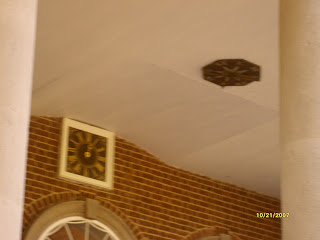
Tell me this does not happen to you, and if you are a home inspector, I will not believe you. You go on vacation or some place with the family, and with out warning you find yourself inspecting the buildings you are in. Does this happen to you?, I know it does, it is something you can’t stop. Well it could just be me, but I don’t think so. I find myself enthralled by the architectural designs and the construction practices I find in historic buildings. When I think of places I have been that have intrigued me the most, I first think of one of the finest examples early Classical Revival style houses in the U.S.. This house is located just outside of Charlottesville, Va., and the third president of the United States designed it. It was constructed between 1768 and 1809, and the exterior was strongly influenced by the work of Andrea Palladio, an Italian architect from the 1500’s. Have you guessed what structure I am talking about? Okay, just in case you have not, here are some more clues; the final structure is a three-story brick building with an octagonal dome. The interior consists of over thirty differently shaped rooms, and one of the most unique clocks in the world. Yes you are correct it is Thomas Jefferson’s Monticello.
If you ever find yourself near Charlottesville, VA, do yourself a favor, and inspect this piece of history.


I hope you like the pictures from my vacation.